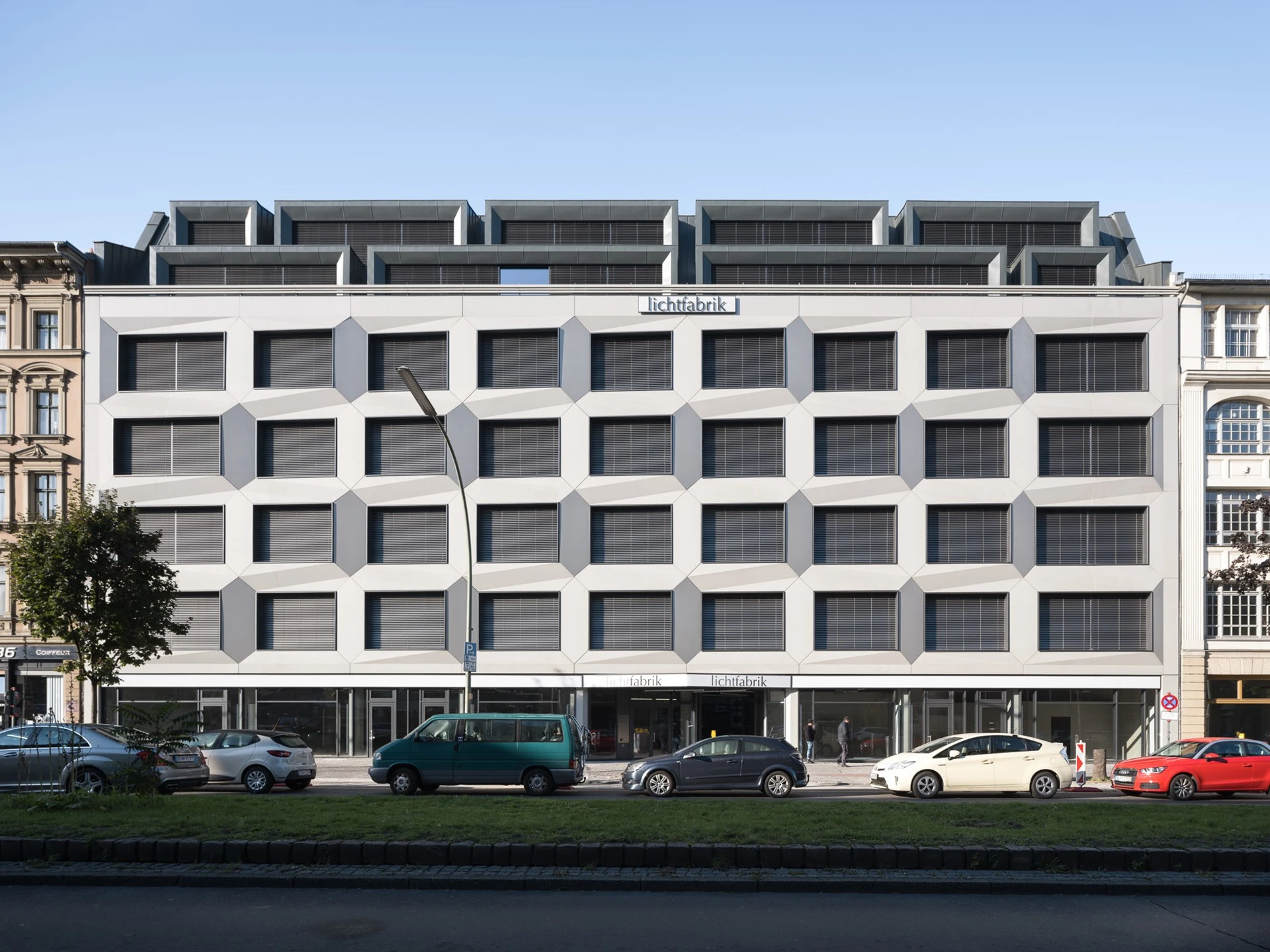
Lichtfabrik Berlin
- ArchitectBollinger + Fehlig Architekten BDA (Berlin) & Stoeckert Architekten (Berlin)
- Year2020
- PhotographerMarcus Ebener
- CountryGermany
Three-dimensional and heritage-compliant Façade of the new Lichtfabrik in Berlin realized with Wicona window systems
In the Berlin district of Kreuzberg, the expansion of the traditional Lichtfabrik commercial courtyard has been completed. Designed by the Berlin offices Bollinger+Fehlig Architekten and Stoeckert Architekten, the loft-style commercial building combines the high demands of heritage protection with contemporary architecture, impressing above all with its folded, prism-like façade solution – realized with three-dimensional glass fiber concrete elements and high-quality aluminium systems from Wicona.
The new Lichtfabrik in Berlin’s Luisenstadt closes a decades-old 45-meter-long gap in the street and completes the heterogeneous streetscape – in harmonious correspondence with the opposite and adjacent buildings. The building, constructed as a closed block, comprises five floors and two recessed attic levels, and houses the new main entrance to the already existing commercial courtyards and staircases.
The commercial building was designed for business tenants – especially artists and creatives – and offers both office spaces and retail units on the ground floor. The design of the building mass takes up the traditional structure of Berlin commercial courtyards and aligns it with contemporary, independent architecture.
Dipl.-Ing. Michael Pape from Stoeckert Architekten explains: “Our design was not intended to be a direct translation or a replica of the well-known structures, but rather an up-to-date interpretation expressing its independence through its own architectural language and entering into direct dialogue with the surrounding buildings.”
Polygonal Tilted Façade with Aluminium Windows
The architects designed an individual and charismatic façade solution that not only impresses visually but also meets the stringent requirements of heritage protection. The building mass and façade articulation, including the two-story sloped roof with large dormers, respect the listed original Lichtfabrik building while providing a contemporary interpretation.
The façade structure was realized using polygonally tilted, prefabricated glass fiber concrete elements combined with slightly angled pairs of windows. This transforms the planar surface of the curtain wall into a three-dimensionally modulated envelope, creating a playful interplay of sill, lintel, and side reveal around the windows. The windows of the new Lichtfabrik were executed with modular aluminium systems from WICONA.
Michael Pape explains: “We initially favored a different solution, but our metalwork partner Unterfurtner Metallbau quickly convinced us, after building a 1:1 model, to use the WICONA 75 MAX window system.”
Maximum Transparency and Concealed Hardware The exceptional feature of WICLINE 75 MAX is that its extremely slim profiles allow for a very high proportion of transparent surface, ensuring excellent outward views. It also impresses aesthetically: fixed and operable panels are nearly indistinguishable. Concealed hinges and fittings provide clean, uninterrupted lines from the inside, and the frame-colored window handle is hidden in the sash, contributing to a homogeneous appearance.
Martin Denk adds: “WICONA 75 MAX also provides excellent sound insulation and outstanding thermal performance. With a low Uw value of 1.2 W/(m²K), it meets the highest energy-saving standards. And last but not least, the windows are very easy and time-efficient to manufacture and install.”
In the base zone of the Lichtfabrik – structured by large-format fixed glazing and prominently visible supports – the metalwork specialists from Unterfurtner Metallbau used the WICTEC 50 façade system. The elements, manufactured at the company’s plant in Braunau (Austria), were delivered directly to the Lichtfabrik site and installed on schedule.
Efficient Construction Process Thanks to 3D Planning in BIM Another project highlight: the entire façade solution was planned in 3D using Building Information Modeling (BIM). Michael Pape explains: “Digital 3D planning up to design phase 5 allowed us much more efficient project coordination with the structural engineer, MEP planner, and client. We could easily exchange and visualize our façade designs and discuss them – in some cases using 3D-printed models – with all stakeholders.”
Conclusion: An impressive project that perfectly unites tradition, heritage protection, and future-oriented construction.
Project Data Sheet
Project: Office/Commercial Building Lichtfabrik
Client/Developer: Nicolas Berggruen Holdings GmbH
Design/Planning: Bollinger + Fehlig Architekten BDA (Berlin) Stoeckert Architekten (Berlin)
Metal/Façade Construction: Unterfurtner GesmbH Metallbau (Austria / St. Peter am Hart)
Aluminium Façade System: Hydro Building Systems Austria GmbH
Completion: 2020
WICONA systems used
WICLINE 75 MAX
Want to know more?
Contact us
Are you looking for professional advice? Do you have a suggestion that you would like to share with us? Get in contact with an expert by clicking on the link below.
Contact us