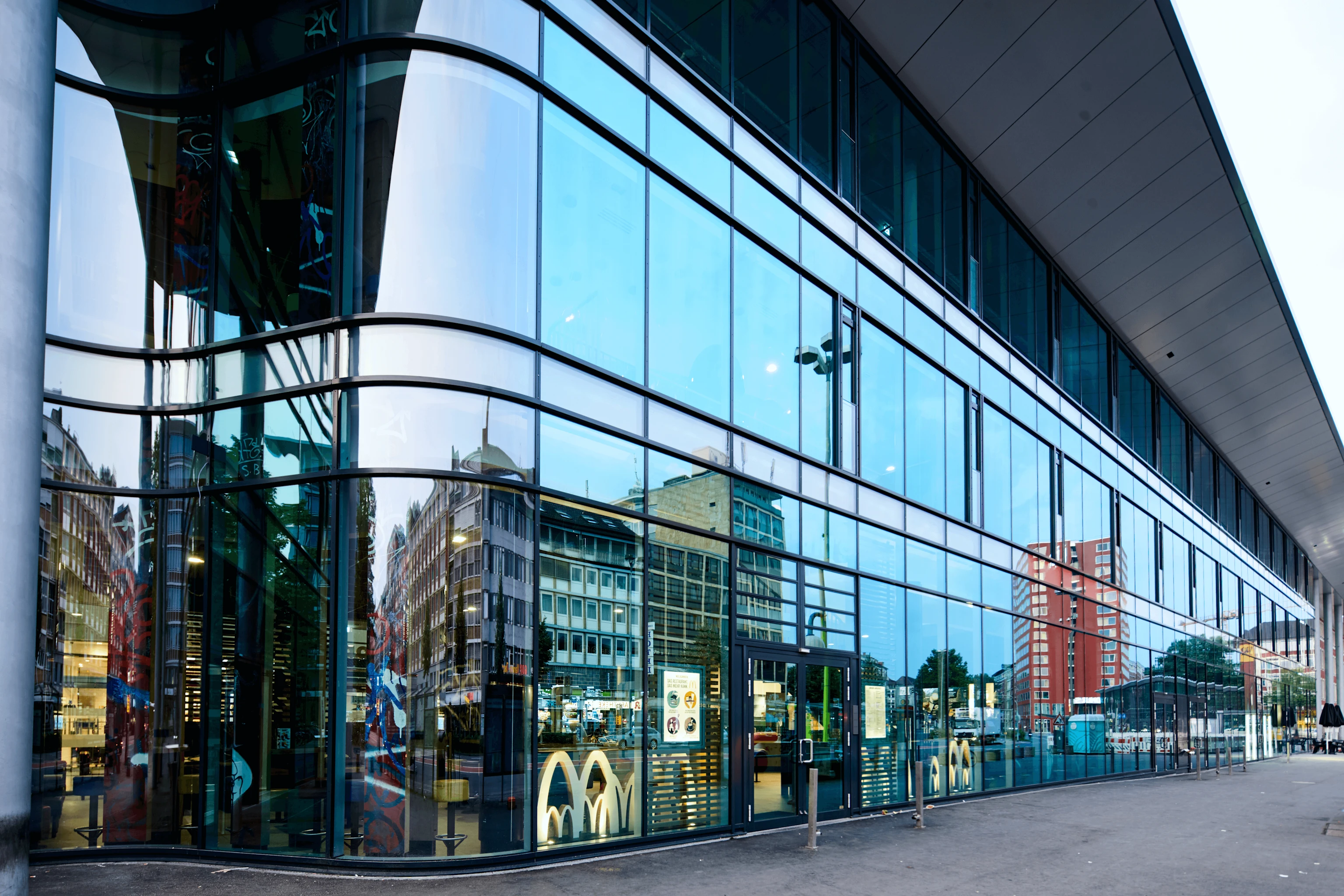
Münster (Westf) Hbf
- Year2017
- CityMünster
- CountryGermany
“Lines Must Flow!”
This guiding principle of DB’s chief architect Marc Ulrich from 2011 shapes the new entrance building of Münster Central Station. The planner, who passed away in 2015, gave numerous stations their characteristic identity. In this Westphalian university city, the generous glass façade, elegantly curved and transparent, has indeed become a true calling card for the city.
Bright, inviting, and well-structured, the new entrance hall on the west side of Münster Central Station welcomes travelers. The new building integrates the adjacent historic building with punched windows from the 1950s, modernizes it, and connects all building parts through a large central hall, which forms the heart of the station. According to Deutsche Bahn, approximately €76 million was invested at the site, around €40 million of which went into the building itself. Nearly 70,000 people use this nationally significant transport hub every day, enjoying all the comforts of modern infrastructure, including a typical mix of retail, fast food, and services in a tidy urban setting. In addition, flexible office and storage spaces are available on the third floor.
In Münster, the Deutsche Bahn tracks run on an elevated level, separating the historic city center in the west from the districts east of the tracks. The new entrance building thus also serves a connecting function as a ground-level passageway. The east side of the station is currently being redesigned as well.
Flowing Lines in Long Window Bands
The western entrance building of Münster Central Station is a reinforced concrete skeleton structure with a column grid of 8.40 m. Approaching from the historic old town, the new building presents a flowing glass façade of impressive dimensions: 150 m long and up to 12 m high. The detailed planning was carried out by Stuttgart-based architectural office Werner Sobek. By recessing the façade behind the columns at the main and secondary entrances, clearly defined entry points and circulation paths are created into the hall, to the DB service area located in the integrated existing building, and to the platforms. The platform-facing façade incorporates the theme of “flowing lines” with its long window bands, which continue the soft curves of the glazed surfaces above the pedestrian passages. Another highlight of the light-flooded hall is a 110 m long and 4.1 m wide skylight integrated into the roof structure.
Award-Winning Glass Façades
All metalwork, from execution planning to installation, as well as the manufacture of the installed glass, was handled by Hunsrücker Glasveredelung Wagener GmbH & Co. KG (Kirchberg), part of Arnold Glas (Remshalden). Their work on this project was honored with a special prize in the 2018 ISOLAR Group competition.
Post-and-beam façades made of aluminium and steel form the exterior shell of the new building. Despite the system changes, the uniformly flowing design realizes the concept sketched by architect Marc Ulrich as early as 2011. Observers will notice the larger glass elements in the steel façade. Approximately 65 % of the building envelope consists of WICTEC 50 elements from the aluminium system house WICONA. The large entrance areas, glazed façades above the pedestrian passages to the platforms, interior hall façades, and the roof including skylights are constructed in steel.
Special WICTEC 50 Construction
A key technical and design feature is the large curved elements of the aluminium-glass façades. These are special constructions of the WICONA façade profile system WICTEC 50, featuring slim visible widths and a wide range of profile geometries. On the west side, floor-to-ceiling operable elements from the window system WICLINE 75 evo with glass French balconies and doors from WICSTYLE 75 evo were integrated. WICLINE 75 evo also forms the long curved window bands on the east façade facing the tracks.
WICONA closely supervises all its projects. Coordination between the system house and the metal construction company was intensive, according to the team at Hunsrücker Glasveredelung Wagener. One of the main challenges was the logistics of installing the façade elements, given the limited space and ongoing train operations.
Glazed Façade Without External Sun Protection
The glass west façade requires no external sun-shading devices. It is equipped with high-performance solar control glass (ISOLAR SOLARLUX), which lets in ample natural light. This solar-control glass is also used for the window bands and glazing on the east façade and in the roof structure. All façade glazing meets the highest safety standards for personal protection.
WICONA systems used
WICTEC 50
Want to know more?
Contact us
Are you looking for professional advice? Do you have a suggestion that you would like to share with us? Get in contact with an expert by clicking on the link below.
Contact us