- ArchitectAIA Life Designers, Johanne San Architectes et Urbanistes
- Year2024
- PhotographerFranck Deletang
- FabricatorSoclova / Banque des Territoires, Duval Développement Grand-Ouest
- CityAngers
- CountryFrance
An innovative service sector concept
In Angers, the Cours Saint-Laud business district embodies a mixed-use and modern urban vision. Designed by the ANMA Nicolas Michelin agency, it includes an 8,000 m² park, a connection between the train station and the city through soft, multimodal pathways, and modular buildings.
It was within this context that the Station A tertiary project began to take shape in 2018. Guided by new ways of living and working, it aims to be “a place for exchange and sharing that reflects our desire to act positively for future generations,” explains Valérie Dubant-Küng, Managing Director of Real Estate Development at Groupe Duval, the project owner alongside the semi-public company Soclova and the Banque des Territoires, property owners.
Designed as “the first in a series of tertiary buildings where it feels good to work and share,” according to Laurent Rossez, Director of Strategy and Innovation at AIA Life Designers (lead architect), the building embodies “a new architectural dynamic for creating inspiring workplaces,” offering office spaces that are “innovative in the way companies are invited to ‘consume’ their rental areas, sharing a number of functions such as the lobby, work café, meeting rooms, garden, and server room.”
The challenges: high quality of use and environmental impact
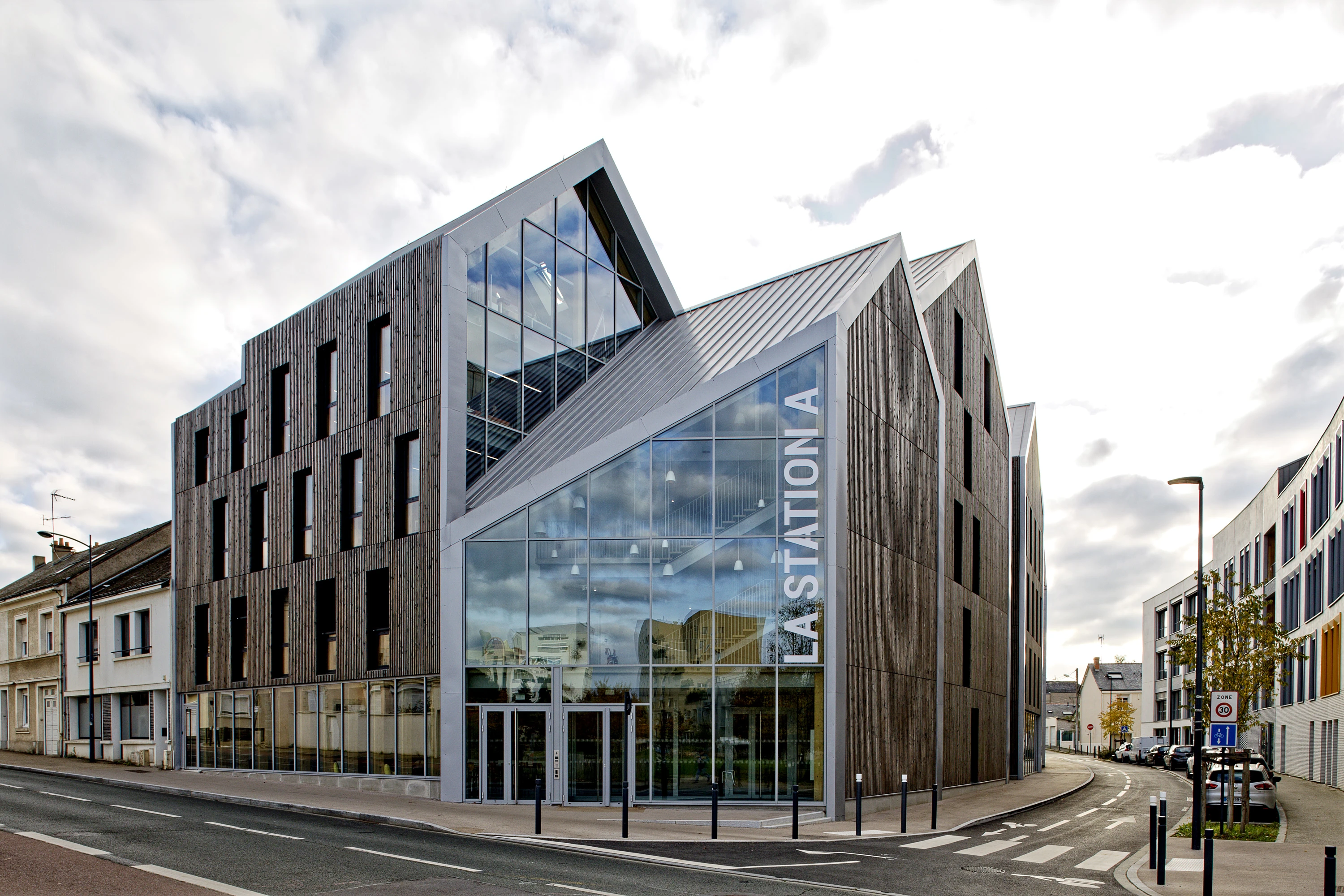
Spread across nearly 2,000 m² in three interlocking volumes distinguished by their pitched roofs, echoing the architectural vocabulary of the housing, the building is a pioneer, even unique, in the region in its response to environmental challenges. From its inception, its stakeholders emphasize, the project aimed for the E2-C2 level of the precursor label to the RE2020 standard, E+/C. In terms of performance, "it employs highly insulating facades for very low energy needs. Carbon emissions are limited in the manufacturing process and during use thanks to the vertical and horizontal load-bearing structures, 75% of which are made of timber." Among the notable innovations, the precast slabs incorporate the SBB® Wood-Concrete process, a composite flooring system, which has held CSTB Technical Approval since 2000 and was developed by AIA Ingénierie. Faced with the demands of these challenges, the choice of window and door frames for the glazed facades focused on WICONA solutions for several reasons. Aesthetically, the sleekness and metallic materiality of aluminum contrast with wood. Environmentally, the composition of WICONA profiles in Hydro CIRCAL® aluminum incorporates at least 75% recycled aluminum, resulting in the best carbon footprint on the market. Finally, the reliability of the technical solutions implemented by WICONA systems, installed by Glass.Go (design and installation) and by Idée Aluminium (manufacturing), is key.
WICONA solutions: finesse and performance
On the building envelope, the architectural approach alternates between wood cladding and transparent elements. These elements combine large glazed facades on the gable walls beneath the pitched roof, resulting in complex geometries. To achieve this, the two WICONA partners worked closely together. The WICTEC 50 grid facade system provides the basis for the curtain walls deployed on several ground-floor facades. Two of these were particularly demanding. The first forms the main facade, at the corner of the building housing the shared spaces. 8.50 meters wide, it rises diagonally to its highest point, 10.70 meters from the ground. It incorporates two WICSTYLE 65 double-leaf doors with three horizontal sections. Overhanging this first curtain wall, positioned more than 11 meters above the ground, the second clads a parallelogram-shaped gable end approximately 8 meters wide. Behind the transparent corner, the vestibule leading to the shared spaces is also entirely glazed. It incorporates a system of fixed WICLINE 65 HI and WICSTYLE 65 frames, arranged in three sections: a central section 6 meters wide, incorporating a door; on one side, a 2-meter return supported by a standard 90° corner post; and on the other, a second return, 1.15 meters wide, supported by a more unusual 149° corner post. The entire assembly rises to a height of 3 meters, aligning with one of the curtain wall transoms of the façade. This structure required reinforcements which, while perfectly fulfilling their function, remain invisible, preserving the airy aesthetic of the architecture.
The benefits: happy designers/occupants!
A few months after the arrival of the first occupants, those who designed Station A, such as Nicolas Dubreil, director of AIA Ingénierie, and Johanne Guichard-Floc’h, architect and managing director of Johanne San (associate architect), are delighted with the result.
For our agencies, we have built a place that reflects who we are and that meets the ambitions we uphold in all our projects: putting people at the center, being close to nature, and implementing future-proof, efficient, and more environmentally friendly construction solutions.
WICONA systems used
Windows WICLINE 65HI
Façades WICTEC 50 NG
Façades WICTEC 50
Want to know more?
Contact us
Are you looking for professional advice? Do you have a suggestion that you would like to share with us? Get in contact with an expert by clicking on the link below.
Contact us