
PROJECT DETAILS
Omega Haus - Circular and forward-looking construction in practice
Cost-effective and sustainable façade revitalisation of the Omega Haus office complex
Extensive work is currently underway to revitalise the ribbon window façades of the iconic Omega Haus office complex in Offenbach am Main, Germany, and make it fit for the future. A key element of the project is a replacement window concept developed by WICONA and the Aluminium façade construction company HEIDENBAUER that impresses with its use of intelligent technology and outstanding cost efficiency. What’s more, WICONA, Saint-Gobain Glass and Semperit, the partners involved in the project are, for the first time, joining their efforts by successfully bringing their end-of-life materials back into the loop in a remarkable example of circular construction in practice.
Renovating an architectural icon
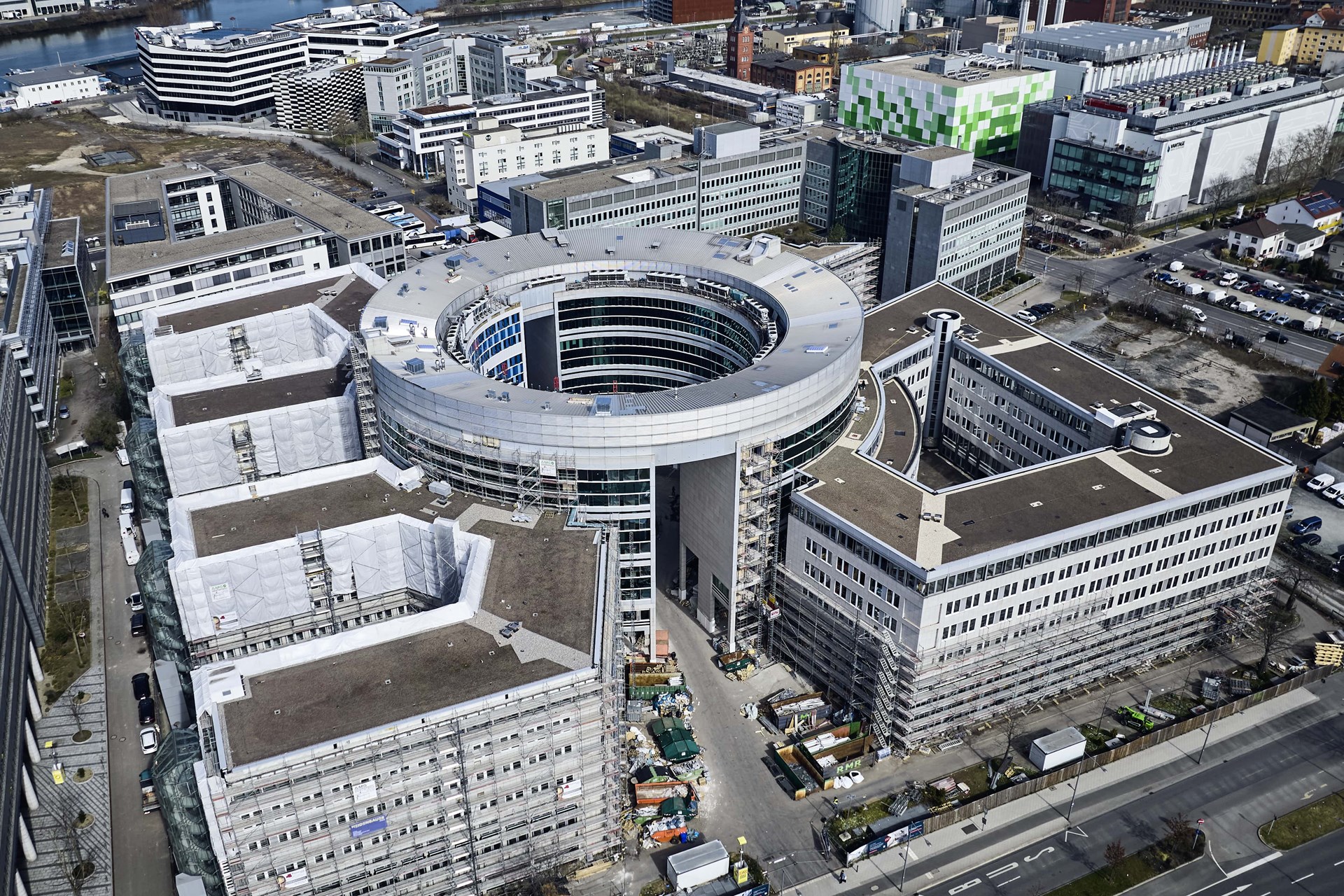
Completed in 1994 and located in the Kaiserlei district of Offenbach, the Omega Haus was designed by prestigious architects Novotny Mähner & Associates for Landesbank Hessen-Thüringen (Helaba). The office complex is a landmark in the area thanks to its stunning design, which features a central, nine-storey rotunda and four adjoining wings, each with six upper floors. As the Omega Haus had reached a point when it could no longer satisfy the latest requirements for energy efficiency and modern working environments, the funds managing Oaktree Capital Management, decided to launch a comprehensive renovation project in their function as building owner. BauSmart Consult was selected to provide technical support for the project’s implementation, with Lefair Development providing commercial support. The aim is to create a building that is sustainable, in harmony with ESG criteria, satisfies Germany’s EGB 55 energy efficiency standard, and achieves LEED Gold certification. It should offer its future users an appealing working environment on a genuine campus, with generous and versatile office spaces in the upper floors and facilities such as catering outlets, a gym, crèche and conference centre on the ground floor. As the only revitalisation project in Germany seeking to achieve compliance with the EGB 55 standard, the Omega Haus is leading the way. “The market shows that a growing number of organisations are looking for and renting energy-efficient, sustainable office space. Oaktree and its project partners are looking to the future and actively helping to shape this trend,” explains Daniel Naab, managing director and owner of BauSmart Consult, who is overseeing the project for Oaktree.
A smart concept – selective façade revitalisation
The renovation works planned by the architects at WGA ZT GmbH will also see the façades and their almost 5,000 windows upgraded. This calls for a solution that can deliver on cost efficiency, energy efficiency and sustainability, while also meeting the authorities’ stipulations that the look of the building should be preserved. The façade construction companies HEIDENBAUER and WICONA worked together to develop replacement windows tailored specifically to the project requirements. The concept involves replacing only the infills and the opening units, while retaining the existing frame structure. Dietmar Brüderl, the head of WICONA Project Service, explains: “The replacement window is the optimum solution here, because the existing outer window frames and their connections to the surrounding building fabric still offer adequate load-bearing capacity, tightness and thermal insulation. Thanks to our smart concept, we have been able to achieve a really far-reaching improvement in thermal insulation and the usability of the entire construction with a very limited and selective intervention in the building’s structure. It is an ideal alternative to the much more resource, time and cost-intensive option of replacing the entire façade.”
Genuine circular economy in practice
During the work, a digital twin was first generated for each window to establish an optimum database for efficient production planning, logistics and subsequent facility management. The next step was to dismantle the old windows floor by floor. Once removed, the windows were taken to on-site containers where they were separated into aluminium, glass and EPDM gaskets. The end-of-life aluminium components were transported to a Hydro recycling plant and recycled using a patented process verified by an independent auditor (DNV). Meanwhile, a specialist glass recycler working to the highest quality standards collected, sorted and crushed the recovered glass to produce cullet that was free from impurities and could be melted down. The molten glass was then used to create low-carbon flat glass. The Semperit EPDM gaskets removed from the windows were analysed, shredded and then sent for devulcanisation. In defined proportions, the resultant non-vulcanised EPDM can then be added to new Semperit EPDM gaskets for windows, doors and façades.
The new window sashes were manufactured from aluminium alloy at the HEIDENBAUER plant in Bruck an der Mur. They consist of at least 75% recycled end-of-life aluminium with a carbon footprint of just 1.9 kg of CO2 per kg of aluminium. Dietmar Brüderl: “We have closed the loop. Old, end-of-life windows are being turned into materials for new, contemporary windows. Our refurbishment concept is also saving on CO2 emissions in many different ways. On the one hand, we are using fewer materials, since we are only replacing the sashes and infills. The Hydro CIRCAL 75R alloy we are using means the replacement process itself has a very small carbon footprint. On the other hand, the upgrade of the façade for higher energy efficiency reduces the heating demand and thereby helps us save on CO₂ emissions in a third way.”
Intelligent installation approach
One of the key requirements in the revitalisation project was to coordinate the new window sashes perfectly with the building’s pre-existing framing construction. Thomas Blacher, Managing Director for Aluminium at HEIDENBAUER, explains: “To compensate for tolerances and ensure reliable tightness, we developed a project-specific adapter frame with integrated tolerance compensation for the pre-existing window frame.” Before the sashes are installed, the adapter frame is simply fitted into the pre-existing aluminium window frame, centred for tolerance purposes and fixed. After that, the new glazing is fitted. Thanks to precise planning and prefabrication, it was possible to replace up to 150 windows per week. In addition to window units with openable sashes, the fixed lights of the façade were also replaced and adapted in terms of their energy performance and appearance. Thomas Blacher: “The new windows and fixed lights with triple glazing achieve a U value of less than 0.99 W/m²K and satisfy all the EGB 55 values specified by the client. They feature an outstanding air permeability Class 4 to EN 12207 and water tightness Class 9A to EN 12208.”
Thanks to close collaboration by the industry partners WICONA, Saint-Gobain Glass and Semperit and the HEIDENBAUER façade engineering specialist, work to revitalise the façade of the Omega Haus turned out to be a model project for circular and forward-looking construction.


